
Searching for reliable information about online companionship services can be challenging when websites, directories, and social media accounts contain incomplete or misleading information. Fake Escort Profiles are a concern for people who encounter suspicious listings, copied photographs, false identities, or unexpected payment requests while browsing online.
Some fraudulent profiles are created to collect advance payments without providing the advertised service. Others may use stolen photographs, impersonate real individuals, or attempt to obtain private information from unsuspecting users. These situations can lead to financial losses, privacy problems, identity misuse, and unnecessary stress.
Understanding the warning signs can help people make better decisions before responding to an unfamiliar profile or sharing personal information.
This guide explains eight common signs of fake escort profiles, including stolen photos, suspicious payment requests, inconsistent details, misleading reviews, and identity fraud. It also covers practical verification methods, online privacy precautions, and steps to take if you encounter a suspicious listing.
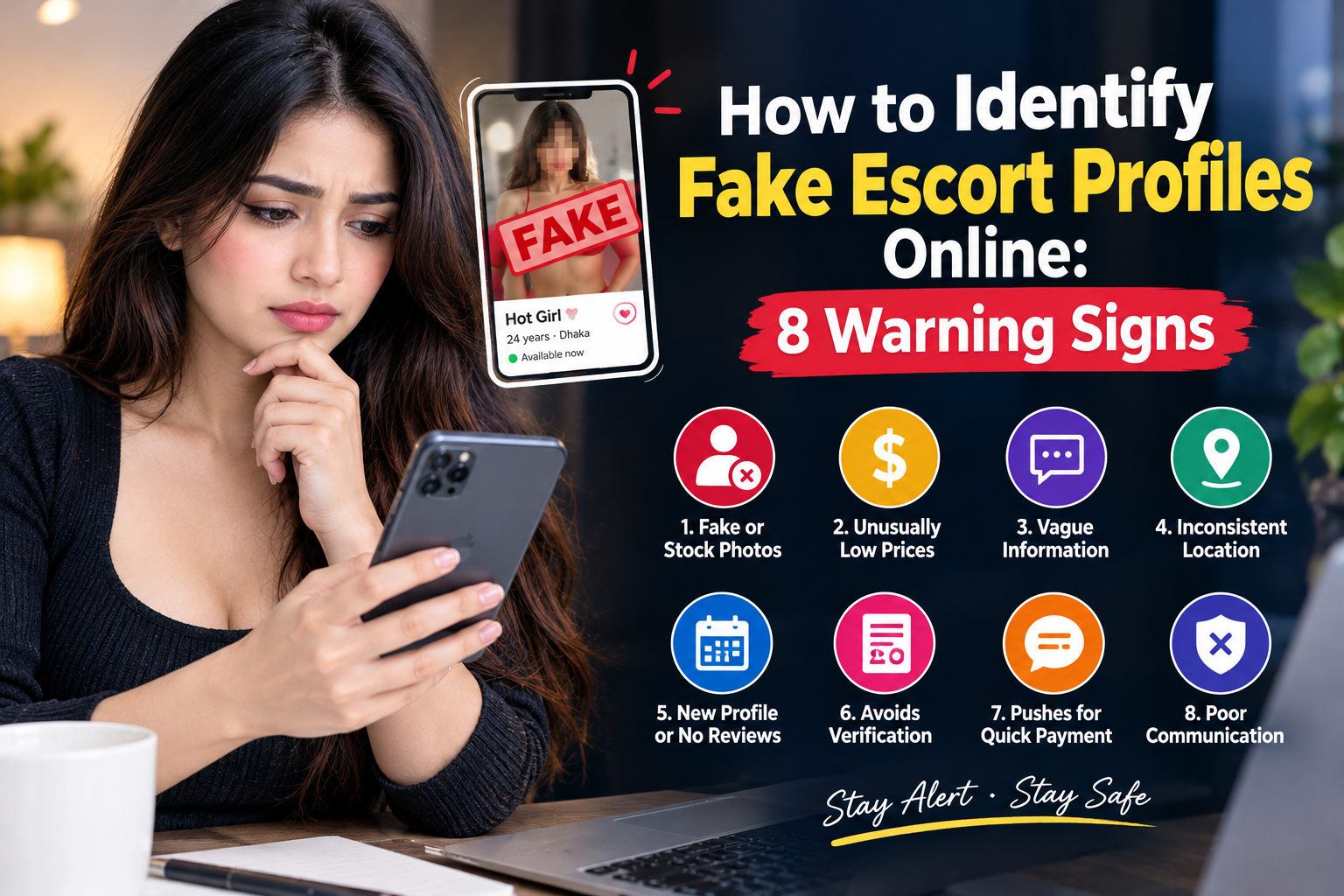
Whether you are researching an online directory in Dhaka or browsing a website serving an international audience, the same basic principles apply: verify available information, avoid rushed financial decisions, and protect your personal details.
What Are Fake Escort Profiles?
Fake escort profiles are online listings or accounts that misrepresent a person’s identity, photographs, services, availability, or other important information.
These profiles may appear on websites, online directories, social media platforms, messaging applications, or classified advertising pages.
Not every incomplete profile is fraudulent, and a legitimate profile may contain outdated information. However, several inconsistencies combined with suspicious requests can indicate a potential scam.
Common examples include:
-
A profile using photographs copied from another person’s public account.
-
A listing that advertises services but provides no consistent information about the business or provider.
-
An account requesting money before explaining the terms of an arrangement.
-
A profile using fabricated testimonials to create a false impression of credibility.
-
A person impersonating someone else to obtain money or personal information.
Recognizing these patterns is an important part of online safety.
8 Warning Signs of Fake Escort Profiles Online
1. Stolen or Misleading Profile Photos
One of the first warning signs to examine is the use of photographs that may not belong to the person represented in the profile.
Fraudulent accounts sometimes copy images from public social media profiles, photography websites, older advertisements, or unrelated online directories. They may use these images to create a convincing identity without the photographed person’s permission.
However, professional photographs or edited images alone do not prove that a profile is fake.
What to look for:
-
The same photograph appears under different names or unrelated listings.
-
Images are associated with different locations or contradictory biographies.
-
The profile contains photographs that appear to represent several different people.
-
The account refuses to clarify reasonable questions about the authenticity of its listing.
-
Images appear elsewhere online with a different identity or context.
How to check: You can use a reputable reverse-image search service to see whether a photograph appears elsewhere on the internet. Compare the surrounding context and dates rather than relying on a single matching result.
Remember that photographs can be legitimately reused by the same person across multiple platforms. A matching image is a reason to investigate further, not conclusive proof of fraud.
Also, avoid downloading or distributing private images without permission. Your goal should be to assess the credibility of a listing while respecting the privacy of the person depicted.
2. Suspicious Advance Payment Requests
Unexpected payment demands are another important warning sign when evaluating online listings.
Some fraudulent accounts request deposits, registration fees, verification charges, travel payments, or other advance payments without providing clear terms. After receiving money, the account may stop responding or demand additional payments.
A deposit is not automatically evidence of a scam. Some legitimate businesses use deposits under documented booking policies. The concern arises when payment requests are unexplained, repeatedly changed, or accompanied by pressure.
Warning signs include:
-
Being told to pay immediately or lose an opportunity.
-
Receiving new charges after an earlier payment has already been made.
-
Being asked to pay an unexplained fee to release a supposed refund.
-
Receiving inconsistent payment instructions from different accounts.
-
Being asked to transfer money to an unrelated recipient without a reasonable explanation.
-
Facing threats or intimidation when questioning a payment request.
How to protect yourself:
Before making any payment, ask for written information about the total amount, the recipient, the purpose of the charge, and the cancellation or refund conditions.
Avoid sending money simply because someone claims an offer is limited or urgent. If the terms keep changing, pause the transaction and independently verify the business.
Never share banking passwords, payment PINs, one-time verification codes, or other credentials with an unfamiliar contact.
3. Inconsistent Names, Locations, and Contact Details
A profile may look convincing at first but contain conflicting information when you examine it more closely.
For example, the same account might use different names across its website and social media pages, provide multiple unexplained telephone numbers, or describe different locations without clarifying the discrepancy.
These differences may indicate impersonation, an outdated listing, or poor account management. They should be assessed in context rather than treated as automatic proof of fraud.
Check the following details:
-
Does the name remain consistent across the listing and its official contact channels?
-
Does the stated location match the information provided elsewhere?
-
Are contact details consistent with the website’s published business information?
-
Do service descriptions change significantly between pages?
-
Does the account provide contradictory explanations when asked a basic question?
For a Dhaka-based directory, for example, a listing may mention Gulshan in one place and another area in a different section. This could have a legitimate explanation, but the provider should be able to clarify the discrepancy.
Best practice: Compare multiple pieces of information and ask for clarification before making a decision. Avoid publishing accusations or personal details about someone merely because a profile contains an inconsistency.
4. No Credible Information About the Provider or Business
An online profile does not need to disclose every personal detail to be legitimate. Nevertheless, a listing should provide enough accurate information for a reader to understand what is being offered and which policies apply.
Potentially concerning signs include:
-
No clear description of the advertised service.
-
Missing or contradictory booking conditions.
-
No understandable explanation of payment requirements.
-
Contact information that changes repeatedly without explanation.
-
Claims of verification that cannot be substantiated.
-
A website that impersonates a known business or misuses another organization’s identity.
Be careful with websites that display verification badges or claim to be officially approved without explaining what those claims mean.
A badge, professional layout, or secure website connection does not independently establish the identity or trustworthiness of the person behind a listing.
How to assess credibility: Review the website’s terms, privacy policy, contact information, and available business details. Where a business claims to have a registration or certification, check whether the relevant issuing organization can independently confirm it.
Do not assume that a missing personal photograph, private identity, or limited online history automatically means a profile is fake. Focus on material inconsistencies and verifiable claims.
5. Pressure to Move to Private Messaging Immediately
Fraudulent accounts may attempt to move a conversation away from a platform where the listing can be reviewed or reported.
They may insist on communicating through an unfamiliar messaging application, claim that the original platform is unavailable, or ask the user to delete previous messages.
Moving to another communication channel is not inherently suspicious. Many legitimate businesses use messaging applications for enquiries. The warning sign is pressure combined with secrecy, contradictory information, or requests that appear unsafe.
Be cautious if a contact:
-
Refuses to answer basic questions through the original platform.
-
Insists that all records of the conversation be deleted.
-
Sends unfamiliar files or links that require unexpected downloads.
-
Requests sensitive personal information without explaining why it is needed.
-
Uses threats or emotional pressure to discourage independent verification.
How to stay safe: Keep relevant booking information and written terms. Avoid opening suspicious links, downloading unknown files, or providing account credentials.
If you suspect fraud, stop communicating where appropriate and use the platform’s reporting tools. You do not need to continue a conversation simply because someone insists that you do so.
6. Fake Reviews and Exaggerated Testimonials
Reviews can help people understand other users’ experiences, but they are not always reliable.
Some fraudulent websites publish fabricated testimonials, copy reviews from unrelated businesses, or create several accounts to make a listing appear more popular than it is.
At the same time, short reviews, anonymous feedback, or a small number of testimonials do not automatically mean that a business is dishonest.
Possible warning signs include:
-
Many reviews appearing within an unusually short period.
-
Repeated wording across multiple supposedly independent testimonials.
-
Reviews that discuss different businesses while naming the same provider.
-
Generic praise without any meaningful description of the experience.
-
Ratings that conflict with the details in the written feedback.
-
Testimonials that appear to have been copied from unrelated websites.
How to evaluate reviews:
Read a range of feedback instead of focusing exclusively on the highest ratings. Look for specific, consistent observations and consider whether the reviewer history provides useful context.
Check multiple independent sources when available. Keep in mind that reviews can be manipulated in either direction, and even a genuine review represents one person’s experience rather than a guarantee of future performance.
For website owners, publishing authentic feedback with appropriate permission is preferable to creating artificial testimonials that could mislead readers.
7. Requests for Sensitive Personal Information
Identity fraud can begin when someone persuades another person to disclose information that is not necessary for an enquiry.
A fraudulent account may ask for identity documents, bank details, home addresses, workplace information, passwords, or verification codes. It might claim that these details are required to confirm a booking or establish trust.
Some legitimate transactions require identity checks, but the purpose, legal basis, handling process, and necessity of the information should be understandable.
Treat these requests with caution:
-
Requests for banking passwords or payment PINs.
-
Requests for one-time passwords or login verification codes.
-
Requests for unnecessary copies of identity documents.
-
Requests for financial information unrelated to the stated transaction.
-
Requests to install an unfamiliar application to complete a verification process.
-
Requests to provide another person’s private information without permission.
Protect your identity:
Share only the minimum information necessary. Verify the identity and legitimacy of the organization before providing sensitive documents, and check how the information will be stored and used.
If an unexpected link asks you to sign in, access the relevant service through its official website or application instead of following the link.
If you have already disclosed credentials or financial information, contact the relevant bank or service provider promptly, secure affected accounts, and follow its official recovery instructions.
8. Threats, Blackmail, or Requests for Additional Money
Threats and blackmail are serious warning signs that require a different response from an ordinary booking dispute.
A fraudulent contact may claim to possess private messages or personal information and demand money to prevent disclosure. The person may use fear, embarrassment, or threats involving family members and employers to pressure the recipient into paying.
Paying does not guarantee that the threats will stop. In some cases, another demand may follow.
If this happens:
-
Do not rush into sending money because of a threat.
-
Preserve relevant messages, account names, payment records, and other evidence.
-
Avoid sending additional intimate photographs, identity documents, or sensitive information.
-
Secure your messaging, email, and social media accounts, including their privacy settings.
-
Contact your bank or payment provider if a transaction has occurred.
-
Seek assistance from appropriate local authorities if you are threatened, extorted, or in immediate danger.
If a person threatens to publish private information, remember that you do not have to handle the situation alone. Seek support from someone you trust and use official reporting channels.
Avoid retaliating, threatening the other person, or publicly sharing their private information. Focus on protecting yourself and preserving evidence.
How to Verify an Online Profile Before Making a Decision
Recognizing individual warning signs is useful, but a consistent verification process is even better.
Use the following checklist when assessing an unfamiliar online listing.
| Verification step | What to do |
|---|---|
| Photo review | Check whether images appear elsewhere in an unrelated context. |
| Information consistency | Compare names, locations, contact details, and service descriptions. |
| Policy review | Read payment, cancellation, refund, and privacy terms. |
| Independent checks | Look for credible information from sources independent of the listing. |
| Communication | Ask reasonable questions and assess whether the answers are consistent. |
| Payment safety | Avoid unexplained fees, pressure tactics, and suspicious payment channels. |
| Data protection | Do not share unnecessary personal or financial information. |
| Reporting options | Check how the platform handles complaints and suspicious accounts. |
No single check can guarantee that an account is genuine. The objective is to gather enough consistent information to make a more informed decision and recognize when it is safer to stop.
What to Do If You Have Already Contacted a Fake Profile
Discovering that a profile may be fraudulent can be upsetting, particularly if you have already shared information or made a payment. Acting calmly and promptly can help limit further harm.
If You Have Sent Money
Contact your bank, card issuer, mobile financial service provider, or payment platform as soon as possible. Explain that you suspect fraud and ask whether the transaction can be stopped, disputed, or investigated.
Keep receipts, transaction references, messages, and account details. Recovery is not guaranteed, but early reporting may help.
If You Shared Personal Information
Change any affected passwords, enable multifactor authentication where available, and review account recovery settings. If you shared identity documents, ask the relevant issuing organization what protective steps are available.
Watch for unexpected login alerts, unusual account activity, or new messages requesting further information.
If You Encountered Blackmail
Preserve the messages and relevant account details. Avoid sending more money or information under pressure, and report the incident through the appropriate platform and local authorities.
If there is an immediate threat to your physical safety, contact local emergency services or seek help from a trusted person.
If You Found a Copied Photograph
If you can identify the original image owner or the relevant platform, report the suspected misuse through its official process. Do not assume that the person shown in the photograph created the fraudulent account.
Respect privacy and avoid spreading the image further while trying to establish its origin.
Frequently Asked Questions About Fake Escort Profiles
1. What are the most common signs of fake escort profiles?
Common warning signs include stolen photographs, inconsistent details, unexplained payment requests, fabricated reviews, pressure to move conversations, and requests for sensitive information.
One warning sign alone does not prove fraud. Consider the overall context and look for multiple inconsistencies.
2. Can reverse-image search identify stolen profile photos?
Reverse-image search can help locate matching photographs elsewhere online. However, it cannot always establish who owns an image or whether a particular profile is fraudulent.
Use the results as one part of a broader verification process.
3. Are advance payments always a sign of an escort scam?
No. Some businesses use deposits under clearly explained policies. Be cautious when the payment purpose is unclear, the terms change repeatedly, or the contact uses threats or pressure to obtain money.
4. How can I recognize a fake online review?
Look for repeated language, unusual review patterns, contradictory details, and feedback that appears unrelated to the service. Compare independent sources when available, but remember that online reviews are not definitive proof.
5. What should I do if someone requests my verification code?
Do not share a one-time password, account recovery code, or login verification code with another person. If the request appears suspicious, stop and access the relevant service through its official channel.
6. Can a professional-looking website still be fraudulent?
Yes. A polished design, security certificate, verification badge, or large number of testimonials does not guarantee that a business is legitimate. Check the underlying information and policies.
7. Should I pay someone who threatens to expose my messages?
Do not make a rushed payment under pressure. Preserve evidence, report the threat, secure your accounts, and seek help from your payment provider or appropriate local authorities.
8. How can website owners help readers avoid fake profiles?
Website owners can publish accurate information, remove impersonation and fraudulent listings, explain verification procedures, provide reporting options, and avoid making unsupported claims about profile authenticity.
Final Thoughts
Fake Escort Profiles can expose people to financial scams, identity theft, privacy violations, and blackmail. Learning to recognize suspicious photographs, unexplained payment requests, inconsistent details, misleading reviews, and demands for sensitive information can help reduce these risks.
The most effective approach is to verify information carefully, avoid rushed financial decisions, protect personal data, and stop communicating when a contact uses threats or suspicious pressure tactics.
For anyone researching online directories in Dhaka or elsewhere, remember that no profile can be considered trustworthy solely because it looks professional. Clear policies, consistent information, independent checks, and responsible handling of personal information provide a more useful basis for evaluating credibility.