
Fake Online Profiles: 10 Dangerous Warning Signs to Avoid in 2026
Fake Online Profiles can create serious risks for internet users,
including identity misuse, phishing, financial fraud and privacy
violations. Learn how to recognize suspicious accounts, verify
information responsibly and protect your personal identity online.
discover information and connect with people. However, not every
account represents a genuine individual. Some profiles use stolen
photographs, misleading personal details or fabricated identities
to gain attention and trust.Recognizing Fake Online Profiles is an important
part of modern digital safety. A suspicious account may attempt
to collect personal information, send harmful links, impersonate
another person or encourage users to make unsafe decisions.
This guide explains ten common warning signs, practical verification
methods and essential privacy habits that can help you make safer
decisions when interacting with unfamiliar accounts.
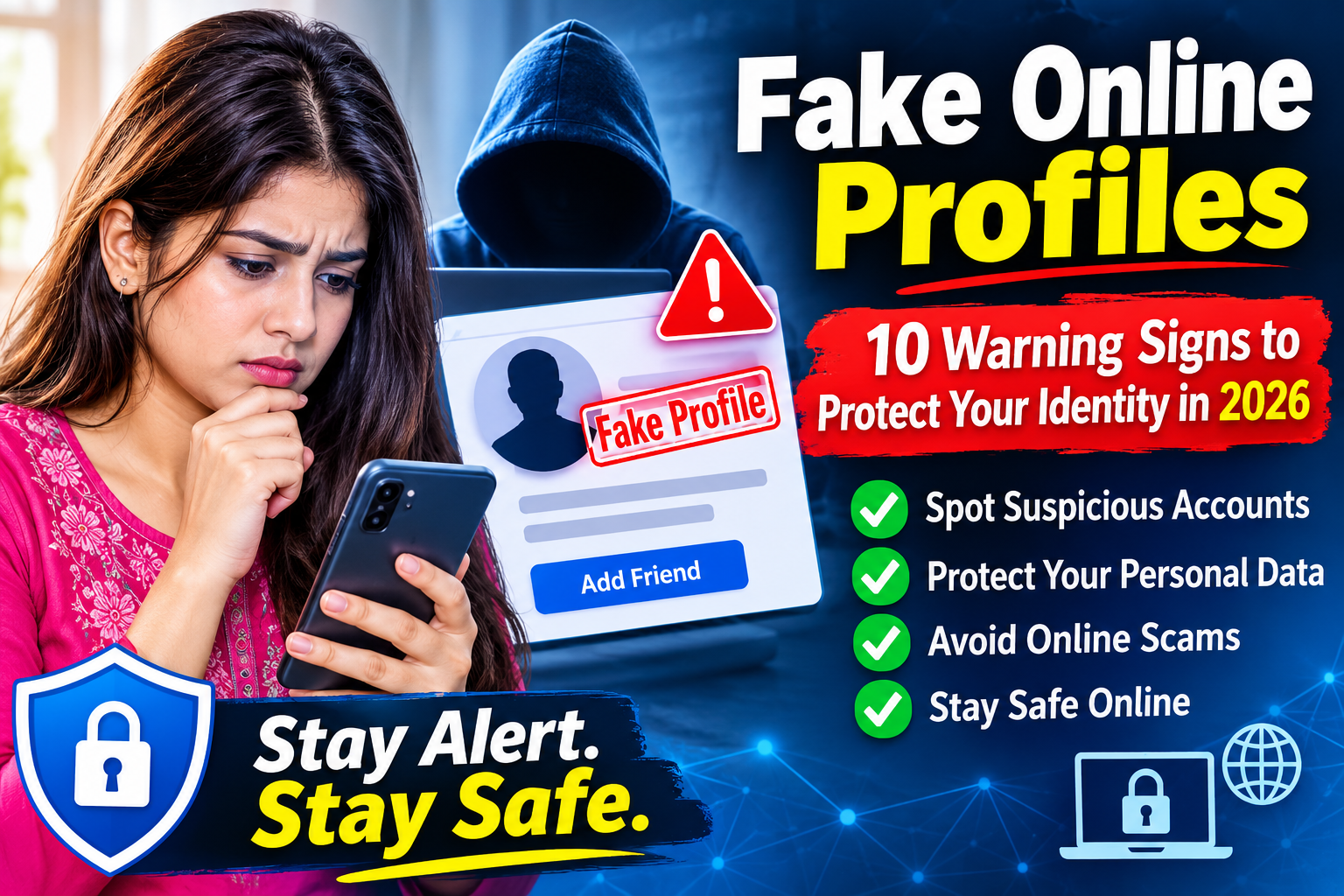
1. What Are Fake Online Profiles?
Fake Online Profiles are accounts that use false, misleading or
unauthorized identity information. They may appear on social
networks, messaging applications, online communities, forums
and other digital platforms.
Some suspicious accounts use photographs taken from other
people’s public profiles. Others create fictional names,
employment histories, locations or biographies to appear
trustworthy.
Common Characteristics
- Photographs that may belong to someone else.
- Incomplete or inconsistent personal information.
- Recently created accounts with little genuine activity.
- Unusual messages or unexpected requests.
- Links to unfamiliar websites.
- Claims that cannot be independently verified.
Remember that a new account or limited profile information does
not automatically prove that someone is dishonest. Look for
multiple warning signs before reaching a conclusion.
2. 10 Warning Signs of Fake Online Profiles
The following warning signs can help you identify accounts
that deserve additional attention. No single sign is definitive,
but several suspicious patterns together may indicate a risk.
Warning Sign 1: Suspicious Profile Photographs
A profile may use a photograph copied from another person’s
social media account, website or public image collection.
The photograph may look professional but provide no reliable
evidence of the account owner’s identity.
Safety tip: Consider using a reputable reverse
image search tool to check whether a photograph appears in
unrelated public contexts. Remember that image matches alone
do not establish who owns an account.
Warning Sign 2: Very Limited Profile History
Some suspicious accounts contain almost no meaningful history.
They may have only one photograph, a short biography and a
limited number of public interactions.
Safety tip: Review the account’s visible history
and consistency. A new account can be legitimate, so consider
this sign together with other evidence.
Warning Sign 3: Inconsistent Personal Information
An account may provide conflicting details about its location,
occupation, education or personal background. Information
shared in different posts may not match the profile biography.
Safety tip: Avoid accepting important claims
without independent confirmation. Do not request or expose
private identity documents to verify an unfamiliar person.
Warning Sign 4: Unusual Messages and Communication
Suspicious accounts may send generic greetings, repetitive
messages or unexpected requests. Some use copied messages
designed to create a quick emotional connection.
Safety tip: Be careful with unsolicited
conversations, especially when the other person quickly
introduces financial matters, personal questions or external links.
Warning Sign 5: Requests for Sensitive Information
An unfamiliar account may ask for your phone number, home
address, identification documents, account credentials or
verification codes.
Safety tip: Never share passwords, one-time
passwords, banking credentials or private documents with
unknown accounts.
Warning Sign 6: Suspicious External Links
Fake accounts sometimes share links that lead to imitation
login pages, phishing websites or unsafe downloads. These
websites may attempt to collect personal or financial information.
Safety tip: Avoid opening unexpected links.
Check the website address carefully and use trusted security
tools such as
Google Safe Browsing.
Warning Sign 7: Pressure to Make Quick Decisions
An account may create urgency by claiming that an opportunity
will disappear, an account will be suspended or an immediate
decision is required.
Safety tip: Take time to evaluate the situation.
Do not let unfamiliar people pressure you into sharing information,
clicking links or making financial decisions.
Warning Sign 8: Unusual Financial Requests
Requests for unexpected payments, gift cards, cryptocurrency
or emergency financial assistance can be warning signs of
online fraud.
Safety tip: Independently verify any financial
claim before taking action. Never send money simply because
an online account creates an emotional or urgent situation.
Warning Sign 9: Limited Genuine Interaction
Some suspicious profiles show unusual engagement patterns,
repetitive comments or interactions that appear unrelated
to the account’s stated identity.
Safety tip: Evaluate the overall account
activity rather than relying only on follower counts,
likes or comments. Engagement numbers can be misleading.
Warning Sign 10: Refusal to Respect Personal Boundaries
A suspicious account may repeatedly ask intrusive questions,
ignore requests to stop communicating or pressure you to
move a conversation to another platform.
Safety tip: You are not required to continue
an uncomfortable conversation. Block or report an account
when appropriate.
3. How to Check Suspicious Profile Photos
Profile photographs can sometimes reveal whether an account
is using images that appear elsewhere online. However, a
photograph search cannot independently confirm someone’s identity.
Practical Image Verification Steps
- Look for unusual cropping, inconsistent image quality or obvious editing.
- Check whether the same photograph appears on unrelated public websites.
- Compare publicly available photographs for obvious inconsistencies.
- Use a reputable reverse image search service when appropriate.
- Avoid downloading suspicious files or installing unknown applications.
theft based only on a matching photograph. Images can be reused,
licensed, shared or reposted for legitimate reasons.
4. How to Verify an Online Profile Safely
Responsible verification means checking available information
without invading someone’s privacy or collecting unnecessary
personal data.
Follow These Verification Practices
- Review the account’s public information for consistency.
- Check whether the account has a reasonable history of activity.
- Look for signs of copied or misleading content.
- Use official platform verification features where available.
- Verify important claims through independent, trusted sources.
- Do not rely on screenshots or follower counts as proof of identity.
- Stop communicating if the account repeatedly creates safety concerns.
For broader digital protection advice, read our
online information and safety resource
and explore the
digital safety blog.
5. Protect Your Personal Information from Fake Online Profiles
Your personal information can be valuable to scammers and
impersonators. Limiting what you share publicly can reduce
the risk of identity misuse and unwanted contact.
Secure Your Accounts
Use strong, unique passwords and enable two-factor
authentication wherever possible.
Review Privacy Settings
Limit who can view your photographs, contact information,
personal posts and other sensitive details.
Protect Verification Codes
Never share one-time passwords, login codes or account
recovery information with unfamiliar people.
Think Before Sharing
Avoid publishing sensitive documents, travel details,
financial information or your exact daily routine.
You can also review the
website resource directory
for additional site information.
6. Common Risks Associated with Fake Online Profiles
Fake accounts can be used in different types of online deception.
Understanding common risks makes it easier to recognize suspicious
behavior before sharing information or taking action.
Identity Impersonation
Someone may use another person’s name, photograph or public
information to create an account that appears genuine. This
can damage reputations and create confusion among friends,
colleagues and online communities.
Phishing and Account Theft
Suspicious profiles may send links that imitate trusted websites.
Their purpose may be to collect passwords, login credentials
or other sensitive information.
Financial Fraud
Some accounts build trust before introducing false emergencies,
investment opportunities or unexpected payment requests.
Always independently verify financial claims.
Privacy Violations
Personal photographs, contact details and private conversations
may be collected or shared without permission. Avoid sending
sensitive content to people you cannot reliably verify.
Harassment and Emotional Manipulation
Impersonation and deceptive communication can also be used
to pressure, intimidate or repeatedly contact individuals.
Maintain clear boundaries and use platform safety controls.
7. What to Do If You Find a Fake Online Profile
If you believe an account is impersonating someone or attempting
to deceive users, take measured steps to protect yourself.
Step 1: Avoid Further Engagement
Do not share additional personal information, open suspicious
links or respond to threatening messages.
Step 2: Preserve Relevant Evidence
Save relevant screenshots, account usernames, profile URLs,
dates and message records. Do not edit original evidence.
Step 3: Report the Account
Use the platform’s official impersonation, harassment or
suspicious-account reporting process.
Step 4: Block the Account
Use blocking and privacy controls to reduce further
unwanted communication.
Step 5: Secure Your Accounts
Change compromised passwords, enable two-factor authentication
and review recent account activity.
Step 6: Seek Appropriate Assistance
If the incident involves threats, financial loss, identity
misuse or serious harassment, consider contacting the
appropriate platform, financial institution or relevant
authorities.
In Bangladesh, you can consult the official
Bangladesh e-GOV CIRT
website for cybersecurity information and the
Bangladesh Police
website for official information.
8. Online Privacy Checklist: Stay Protected in 2026
Use this checklist to review your everyday online safety habits
and reduce exposure to suspicious accounts.
- Use unique passwords for important online accounts.
- Enable two-factor authentication.
- Keep social media privacy settings updated.
- Do not share passwords or verification codes.
- Check unfamiliar links before opening them.
- Review unexpected messages carefully.
- Limit publicly visible personal information.
- Report suspected impersonation to the platform.
- Block accounts that repeatedly violate your boundaries.
- Keep devices, browsers and applications updated.
Remember These Three Rules
Verify before trusting. Protect information before sharing.
Report suspicious behavior instead of engaging with it.
9. Useful Online Safety Resources
The following organizations provide information about
cybersecurity, privacy, online fraud and digital safety.
Use their official websites to find current guidance.
Bangladesh Cybersecurity Resources
Bangladesh e-GOV CIRT
– Cybersecurity information and advisories.
Bangladesh Police
– Official police information and services.
Bangladesh Laws
– Official legal information.
International Online Safety Resources
FTC Consumer Advice
– Consumer protection and scam awareness.
CISA Secure Our World
– Practical cybersecurity guidance.
National Cybersecurity Alliance
– Online privacy and security education.
Google Safe Browsing
– Information about unsafe websites.
10. Frequently Asked Questions About Fake Online Profiles
1. What are Fake Online Profiles?
Fake Online Profiles are accounts that use false, misleading
or unauthorized identity information. They may imitate real
individuals or present fictional identities.
2. How can I recognize a fake social media account?
Look for multiple warning signs, such as inconsistent profile
details, suspicious photographs, unusual messages, unexpected
links and requests for sensitive information.
3. Are all new social media accounts fake?
No. Genuine users create new accounts regularly. Account age
alone is not enough to determine whether a profile is authentic.
4. Can fake profiles use real people’s photographs?
Yes. Some impersonation accounts use photographs copied from
public websites or social media. A photograph alone cannot
establish the identity of an account owner.
5. Can I verify a profile using reverse image search?
Reverse image search may help identify where a photograph
appears publicly online. However, it cannot independently
confirm the identity of the person using that image.
6. What should I do if someone creates a fake profile using my photo?
Save relevant evidence, report the account through the platform’s
official impersonation process, review your privacy settings
and inform affected contacts when appropriate.
7. Should I respond to suspicious messages?
Avoid sharing information or clicking links. If a message
appears suspicious or threatening, stop engaging and use
the platform’s blocking and reporting tools.
8. Can fake online profiles steal personal information?
They may attempt to collect personal details through deceptive
conversations, phishing links or misleading requests. Never
share passwords, verification codes or sensitive documents.
9. How can I protect my social media identity?
Use strong passwords, enable two-factor authentication,
review privacy settings, limit public personal information
and monitor unusual account activity.
10. Where can I learn more about online safety in Bangladesh?
Visit official resources such as Bangladesh e-GOV CIRT,
Bangladesh Police and Bangladesh Laws for relevant
cybersecurity, safety and legal information.
Conclusion: Stay Alert and Protect Your Digital Identity
Fake Online Profiles can create privacy, security and identity
risks for people using social media and other digital platforms.
Learning to recognize suspicious behavior is an important
step toward safer online communication.
Review profile information carefully, avoid unexpected links,
protect sensitive data and report suspected impersonation
through official platform channels. Remember that no single
warning sign proves an account is fake. Responsible verification
and good privacy habits provide a stronger foundation for
digital safety.
Disclaimer
This article is provided for general educational and online
safety awareness purposes only. It does not identify or accuse
any specific person or account. Platform reporting procedures
and applicable laws may change. Consult official sources
for current information.